NASA spots 54 potentially life-friendly planets
Message boards :
SETI@home Science :
NASA spots 54 potentially life-friendly planets
Message board moderation
Previous · 1 · 2
| Author | Message |
|---|---|
|
C Olival Send message Joined: 6 Sep 10 Posts: 209 Credit: 10,675 RAC: 0 
|
Essentially any interesting rocky planets that Kepler detects, those then become targets for telescopes capable of capturing biomarks in their atmospheres, i would assume. ID: 1084853 ·  |
|
C Olival Send message Joined: 6 Sep 10 Posts: 209 Credit: 10,675 RAC: 0
|
Any ETs out there if they have their radio telescopes pointed toward Earth, (Orion ), i would think that all the space junk that orbit Earth would give off stronger radio signal, artificial signals, any thoughts on that. ID: 1086464 · |
|
Erdmann Send message Joined: 10 Jan 11 Posts: 12 Credit: 719,494 RAC: 3
|
I think you are a bit off on the amount of time that an extra-solar planet around a G0 type star in the 'goldie locks' orbit would take. While our planet takes a year to orbit our sun, someone looking at our system from say 30 light years out, would see the earth transit the sun in a matter of a day or so since it would be looking at an area of oclusion of a degree or less. The problem would be that our earth would only be in a position of detection for that short period .. which makes finding planets close in to a star and it's inherent fast transit time, and short orbital times easier to detect. ID: 1086474 · |
|
C Olival Send message Joined: 6 Sep 10 Posts: 209 Credit: 10,675 RAC: 0
|
The detection of Earth by any listening ETs should be easier if their telescopes are able to block out sun's glare thus perhaps giving off any biomarks on earth's atmosphere. That begs the question, when telescopes here on Earth are able to block off a star's glare, the detection of Earth size planets should be easier. ID: 1086750 · |
 William Rothamel William Rothamel  Send message Joined: 25 Oct 06 Posts: 3756 Credit: 1,999,735 RAC: 4
|
I have just now hit 1,000,000 in credits and have now shut down my six processors after several years of computing for BOINC/SETI. My computers are in my office which is a small (8 x 10) sunroom. All winter I have kept this room around 70 degrees fahrenheit while I set my thermostat on 59 degrees in the part of the house that includes this heating zone. Two computers with six cores and three printers provide significant heat in this space. I will calculate how much electricity this has used and dollars expended on same later on. Over the years I have lost faith in this effort ever being successful as I feel that there won't be many habitable planets in the entire galaxy that would support intelligent life's evolution. I am unsure that these work units will ever be revisited and promising ones aggregated and re-explored. Perhaps in the entire universe there might be a significant number of such planets; but the numbers are probably too few and the space too vast for us to ever know, in my opinion. So for now I will remain an agnostic as far as intelligent, detectable alien life is concerned. I will stay tuned in to what's happening here and redirect the money spent on processing work units to help me stave off bankruptcy. Regards to all Daddio ID: 1086753 · |
skildude  Send message Joined: 4 Oct 00 Posts: 9541 Credit: 50,759,529 RAC: 60 

|
This is not exactly the thread to say goodbye in.  In a rich man's house there is no place to spit but his face. Diogenes Of Sinope ID: 1086758 · |
|
C Olival Send message Joined: 6 Sep 10 Posts: 209 Credit: 10,675 RAC: 0
|
Life is outthere in the Milky Way ID: 1088613 · |
Lynn   Send message Joined: 20 Nov 00 Posts: 14162 Credit: 79,603,650 RAC: 123
|
Our galaxy might be a bit more crowded than we've ever thought. A new study by the scientists at NASA's Jet Propulsion Laboratory in Pasadena, CA suggests that one out of every 37 to one out of every 70 sun-like stars may have an Earth-like planet in it's orbit, according to Space.com. These planets are at such a position that liquid water could exist on the planet's surface, according to the researchers. ~more~ 2 Billion Alien Earths Could Exist In Our Galaxy http://www.huffingtonpost.com/2011/03/23/2-billion-alien-earths_n_839653.html ID: 1089887 · |
|
Michael Watson Send message Joined: 7 Feb 08 Posts: 1384 Credit: 2,098,506 RAC: 5 |
Just to put this in perspective, there are 37 star systems within ~15 light years of Earth. There are 70 star systems within ~19 light years. The nearest planet, potentially inhabitable by life as we know it is probably only 15 to 19 light years distant. Quite close in the galactic scheme of things. Our galaxy is ~ 100,000 light years in diameter. You can use the cube of the distance to expand on this. If there is one habitable planet within 19 light years, there should be 8 such planets within~ 38 light years, and 64 habitable planets within ~76 light years. Michael ID: 1090009 · |
|
William Rothamel Send message Joined: 25 Oct 06 Posts: 3756 Credit: 1,999,735 RAC: 4
|
In spite of other estimates based on a sphere . The Milky Way is a very flat disk. There are a reported 500 main sequence stars within 100 light years. So within 1000 light years there might be 50 000 such stars or perhaps a few thousand 'Habitable" ones. I have seen other estimates that are in the millions?? We have to be very careful what "habitable" means in each of these reports. "Habitable" to produce life such as ours may require more than a dozen parameters to exist and to fall within certain ranges. (Magnetic field, stable circular orbit, water etc). Next we need to calculate how far out we could hear aliens with our current antennas and likely emissions both spurious and intended. ID: 1090044 · |
|
C Olival Send message Joined: 6 Sep 10 Posts: 209 Credit: 10,675 RAC: 0
|
the next step would be to have optical telescopes really powerful capable of imaging a planet 1000 light years way, and with ability to identify biomarks in a planet's atmosphere. ID: 1090184 · |
|
skildude Send message Joined: 4 Oct 00 Posts: 9541 Credit: 50,759,529 RAC: 60
|
Our sun is the separate one just below the first row of stars. Supposedly thats jupiter and earth transiting the sun. 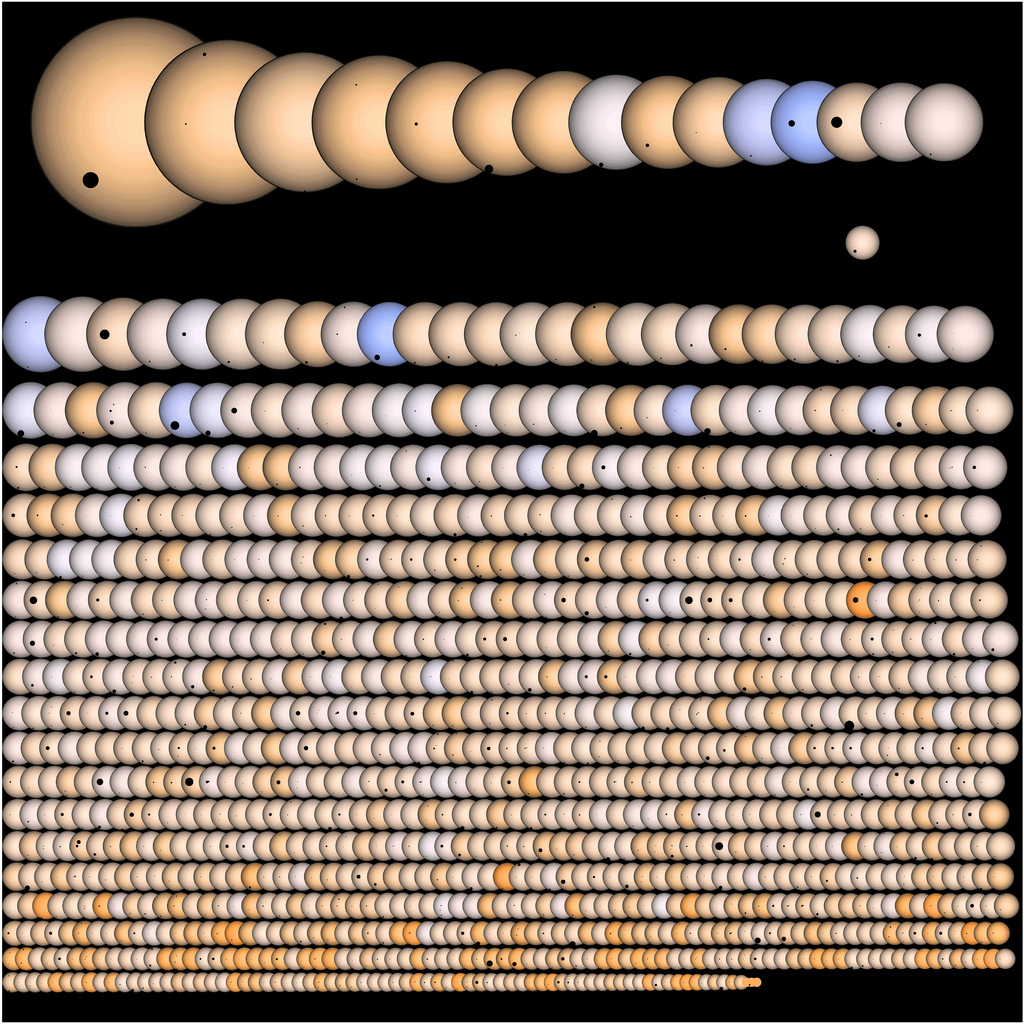 kepplers suns and planets In a rich man's house there is no place to spit but his face. Diogenes Of Sinope ID: 1091446 · |

©2024 University of California
SETI@home and Astropulse are funded by grants from the National Science Foundation, NASA, and donations from SETI@home volunteers. AstroPulse is funded in part by the NSF through grant AST-0307956.